

Thank you for Subscribing to Gov Business Review Weekly Brief

Oklahoma
Kendal Francis, City Manager, Muskogee
Steering Muskogee Into Its Next Chapter
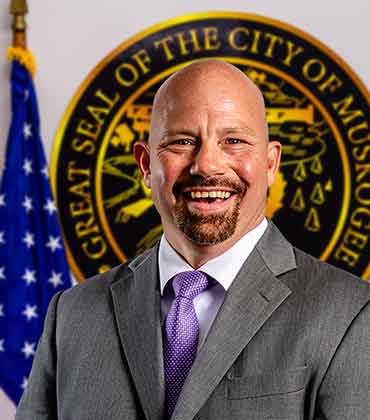
Kendal Francis
Muskogee is not a city that arrived where it is by accident. With Google establishing a data center within our boundaries, a lithium refinery on the horizon and a USD 100 million wastewater infrastructure overhaul already in motion, we are moving with the purposefulness that I believe reflects exactly where this community wants to go.
I came to Muskogee carrying more than three decades of municipal experience, much of it earned at the operational core of city services. I began my career as a water treatment plant operator, working nights, weekends, and holidays. That formative period gave me a firsthand understanding of what public service actually looks like from the ground up. That proximity to the work, and to the people who depend on it, became the organizing principle for everything that followed. Central to that philosophy is a conviction that those closest to the work often understand it best, and that a leader’s role is not to monopolize decisions, but to build a culture where talented people are trusted and equipped to make them. I return often to a story about President John F. Kennedy’s visit to NASA, where he stopped to ask a janitor what he did for the organization. The reply, “I am helping to put a man on the moon” has stayed with me for years. It captures precisely what I want from every employee. A sense of shared mission that transcends title or function. I also draw on thinkers like Simon Sinek, encouraging my staff to move beyond surface motivations and locate a deeper professional purpose. My monthly new-employee orientations are built around that idea, anchoring people not just to job descriptions, but to the broader civic mission those descriptions serve. Rebuilding for Scale Ten months in, I have moved with deliberate speed on two concurrent fronts, restructuring the city’s leadership bench and confronting Muskogee’s most pressing infrastructure demands. In that span, I have filled key positions including assistant city manager, communications manager, planning and community development director, airport manager, and tourism director. Additional vacancies in parks and recreation, police, and public works are expected to be addressed in the months ahead. That pace of hiring was never simply a matter of filling seats. I was assembling a team around a shared leadership philosophy. My criteria were consistent, people who trust their teams, distribute authority throughout the organization, and treat field-level expertise as a resource rather than a challenge. I do not necessarily look for technical expertise. Most of my questioning during interviews is about whether candidates believe what I believe. The urgency behind that build-out is inseparable from Muskogee’s industrial surge. Alongside the Google Data Center, we are seeing construction from companies including Core Scientific, Polaris, and Stardust Lithium. Industrial activity of that scale creates downstream demands across every city department—planning, utilities, policing, public works—and I needed an executive team capable of managing those ripple effects with or without my direct involvement in every decision. A Decision on Day One The clearest early test of that philosophy arrived almost immediately. For roughly a decade, the city had provided two police officers to a local school district as school resource officers. The interim city manager before my arrival had moved to cancel the program because the department was short-staffed, and returning those officers made operational sense. But the decision came without notice to the district, two months before the school year began. Parents and students showed up to council meetings. The pressure was real. I met separately with the superintendent and the police chief, heard both sides, and negotiated a phased transition. No change for the upcoming school year, a reduction to one officer the year after, and full transition out by 2027, giving the district time to build its own capacity. It was not a perfect solution for either side, but it was a workable one. Discipline in an Era of Growth Cities do not have the luxury of pausing daily operations to think about the future. Water runs, streets get repaired, police respond, these responsibilities never stop. The discipline is in building a team and structure that handles the daily load well enough that leadership can lift its eyes to what comes next. That balance shapes everything about how I approach fiscal stewardship. Oklahoma’s municipal finance environment is structurally distinctive. Cities here rely almost entirely on sales tax revenue, without the cushion of ad valorem property taxes. My team approaches budgeting through solid data analysis, clear forecasting assumptions, and a deliberate resistance to short-term optimism. The COVID-19 pandemic stands as a recent reminder of how quickly consumer spending patterns, and by extension municipal revenue, can turn. “The best decisions I have ever been part of were not because I had the answer immediately, but because I slowed down, listened to my team and allowed space for collaboration.” A significant step forward came with the passage of a voter-approved Capital Improvement Plan sales tax, an eight-year extension that funds infrastructure and capital projects without straining the operating budget. The USD100 million wastewater treatment plant initiative sits squarely within that framework, foundational to our ability to sustain industrial growth responsibly. My background in utilities, more than twenty years beginning on the plant floor, lets me engage technical teams as a peer rather than an administrator, and that makes a real difference. The strategic planning process I launched reflects the same thinking. When I arrived, the city had gone years without an updated roadmap. I spent my first months stabilizing leadership and systems precisely so the organization would be ready to think long-term when the time came. That process is now underway, with a consultant engaged to define priorities, metrics, and direction. Earning Trust, Block by Block Transparency was not something Muskogee residents associated with City Hall before I arrived. That was among the first things I heard from the community, and it became an early operational priority, addressed not through formal policy declarations alone, but through a sustained shift in how we communicate and show up. My signature initiative is Kendal’s Koffee—styled with a deliberate K—a quarterly open-forum session at a local coffee shop where I buy breakfast, share updates and take unscripted questions. The sessions also run on Facebook Live for those who cannot attend in person. But the sessions only build trust if something happens afterward. My rule is simple, every question gets an answer, and if we cannot act on something, residents deserve to know why. Engagement that disappears after the applause is just performance. Alongside that, I helped launch a city-focused podcast hosted by local teenagers through the Youth Volunteer Corps to make municipal government feel less distant to those who will one day be its primary stakeholders. Muskogee’s economic positioning reflects similarly deliberate thinking. Local developers talk about the four Rs—roads, river, rail and runway—and few communities in the region can offer all four. We are connected by major highways, served by the McClellan-Kerr Arkansas River Navigation System, linked to multiple Class I rail lines, and anchored by a regional airport. Paired with competitively priced utility infrastructure and a workforce pipeline built through partnerships with Indian Capital Technology Center, Connors State College and Northeastern State University, Muskogee is genuinely differentiated for the industries we are attracting. Leading to Leave It Better When younger administrators ask what advice I would offer, I do not reach for governance frameworks or strategic playbooks. I point to a sign on my office wall. Rule number six: do not take yourself too seriously, because you are not that important. Progress in local government is always a collective accomplishment. Paired with that humility is a longer view I trace back to the Athenian Oath—the obligation to leave the city not merely preserved, but greater and more beautiful than one found it. That standard, civic stewardship measured not in terms but in trajectory, is the frame through which I approach every budget decision, every leadership hire, every infrastructure investment and every conversation over Koffee in Muskogee.The articles from these contributors are based on their personal expertise and viewpoints, and do not necessarily reflect the opinions of their employers or affiliated organizations.
