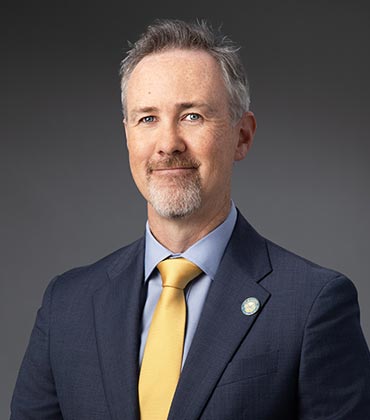
Justin Clifton
Justin Clifton is the City Manager of Murrieta, where he leads a full-service city organization delivering critical public services across multiple functions. His work centers on aligning strategy, operations, and financial discipline. He places a strong emphasis on prioritization, continuous improvement, and delivering measurable value to residents.
Bringing Clarity to Complexity
Local government operates under a simple but demanding expectation. We are responsible for serving everyone, and in my role as City Manager of Murrieta, that expectation shapes both the purpose and the challenge of what we do every day.
Murrieta is a full-service city with nearly 500 employees across police, fire, engineering and community services. While the scale is typical, the complexity isn’t. We are constantly balancing competing demands with limited resources, and our residents expect faster permits, better roads and more amenities, often all at once. We are trying to be all things to all people.
Over time, I have realized that the real problem is not demand but the absence of a clear focus. If everything becomes a priority, then nothing truly is. That idea is not just something. I believe it is built into how the organization operates.
We run annual council planning sessions to define our priorities, and we revisit them mid-year to assess progress and make adjustments. When new ideas come forward, we do not just add them to the list; we evaluate where they fit relative to what we are already doing.
The result is a shift in how we operate. We run fewer parallel initiatives, complete more of what we start, and reduce the internal churn that often slows organizations down. For me, the goal has never been to do more but to ensure that what we choose to do actually gets done.
Prioritization and Financial Discipline Under Constraints
One of the biggest realities in public service is that we are constantly making trade-offs, often without the benefit of clear economic signals that exist in other sectors. Demand continues to grow, but resources do not grow at the same pace, which makes prioritization essential.
Without discipline, organizations stretch too thin. Projects start, but many don’t get completed, creating frustration internally and externally. To address this, we use a three-tiered model: tier one is fully resourced, and in execution, tier two is under development and tier three includes important ideas not yet prioritized.
The goal is not to adopt more technology, but to improve how our organization performs.
What makes the difference is consistent application. If it’s not in the top tier, it doesn’t move. New ideas don’t expand the workload; they are evaluated against existing priorities.
This approach has reduced stalled initiatives and improved follow-through on what matters most. Financial discipline works the same way. We don’t rely on higher budgets; we focus on simplifying processes, removing inefficiencies and investing where work can be completed. The goal is not to start more, but to finish with impact.
Managing Growth, Economic Value and Resilience
Murrieta has experienced sustained growth, and with that growth comes increasing pressure on infrastructure, services and long-term planning. I have found that the biggest risk is not growth itself, but reacting to it too late.
That is why we focus on identifying trends early. We track development pipelines, market activity and even external factors such as insurance trends before they become visible constraints. This allows us to make decisions ahead of demand rather than in response to it.
Our planning is grounded in data. We conduct supply-and-demand analyses across services, from parks and recreation to public safety, so we can align our investments with how residents are actually using our systems today. If we do not do that, we risk building for the past rather than the future.
Economic development is another area where we take an active approach. I, along with members of our city council, regularly participate in industry forums and trade shows to engage directly with businesses considering expansion. These interactions are not just about visibility; they help us build relationships early and move opportunities forward more quickly.
At the same time, we stay closely engaged with brokers and developers to manage vacancies and maintain the right mix of tenants in our commercial spaces. For us, economic development is not passive attraction; it is active pipeline management.
Resilience is built in. We consistently evaluate our infrastructure and service needs in light of changes in development patterns, and we take a proactive approach to preparing for natural disasters and other emergency incidents.
At the same time, we remain flexible in our planning because conditions change and our strategies need to evolve with them.
Leadership Through Relationships and Practical Innovation
For me, leadership is not just about systems and processes; it is about staying connected to the people who make those systems work.
I make it a point to engage regularly with our teams through “Mingle” sessions, informal “Lunch with the City Manager” interactions, and direct outreach to employees across the organization. These conversations give me insight into what is actually happening on the ground, and they help us surface issues early, reduce hierarchy and improve alignment across teams.
We place a strong emphasis on understanding our operations through data. In the absence of profit-driven signals, we rely on metrics such as service timelines, workload patterns and response trends to identify areas for improvement. What gets measured, gets managed and that principle guides our performance management approach.
When it comes to innovation, I believe in taking a disciplined approach. Government is naturally risk-averse, but avoiding change is not an option. We encourage smart risk-taking, where teams can experiment while still being accountable for outcomes. We give team members tools like “lean” process improvement training so they are empowered to identify problems and fix them on their own.
We have also created cross-functional groups to evaluate emerging technologies, including artificial intelligence, with a focus on how these tools integrate with our existing systems, simplify workflows and deliver real operational value. The goal is not to adopt more technology, but to improve how our organization performs.
Looking ahead, I see the challenges becoming more complex. As I often remind myself and our team, “We are responsible for everybody,” and that means we cannot narrow our focus as private organizations can.
At the same time, expectations are rising, perspectives are becoming more polarized and fewer people are choosing careers in public service. These are structural challenges that require clarity, discipline and a strong sense of purpose.
Ultimately, what we are trying to build in Murrieta is not just a set of processes, but a system that consistently turns intent into outcomes, and that, to me, is what effective public leadership is all about.