

Thank you for Subscribing to Gov Business Review Weekly Brief
Gov Business Review: Specials Magazine
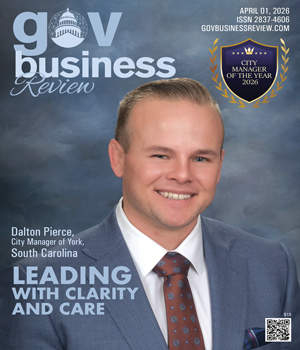
Dalton Pierce, the City Manager of York, South Carolina, is a seasoned leader with a career deeply rooted in public administration. While many city managers take a traditional route through academia and rapid career advancement, Pierce’s journey stands as a testament to the value of hands-on learning and professional grit. Growing up in North Carolina, Pierce discovered his passion for public service during his time at Catawba College. Although initially uncertain about his career direction, he learned about the role of a city manager during his sophomore year—a revelation that sparked a commitment to public administration that would define his professional path. After earning his degree, Pierce began his career with an internship in the Town of Mooresville’s Development Services Department, where he was exposed to a broad range of municipal operations. This formative experience, which included work in GIS, procurement, and engineering, provided a foundational understanding of local government. From there, Pierce expanded his knowledge and expertise through roles at the Town of Indian Trail and later in Blacksburg, each offering new perspectives on managing municipal resources and programs. Along the way, he earned his Master’s degree in Public Administration, reinforcing his commitment to a career dedicated to shaping the future of cities and towns. Now at the helm of York’s municipal government, Pierce brings a unique bottom-up perspective that informs his leadership approach. Having worked in various capacities across several municipalities, he has developed a comprehensive understanding of how local governments function—how they balance budgets, manage resources, and, most importantly, serve their communities.
Top Permitting System Software Consulting 2026
Why are cities and counties struggling to keep pace with rapid permitting technology change? Permitting technology is changing faster than at any point in the past decade. Cities and counties are navigating a wave of change as legacy tools retire and automation and AI enter operational workflows. Internal IT teams supporting dozens of enterprise systems often lack capacity to track the evolving roadmaps of permitting platforms. Park Consulting Group (PCG) helps bridge that gap. The ongoing transition away from Crystal Reports is one example. As support sunsets, agencies must move to modern reporting environments, requiring deep knowledge of permitting databases. PCG helps IT teams manage these transitions, rebuilding reports to ensure accuracy and reliability. Staying on top of emerging capabilities across permitting platforms is equally central to PCG's value. The firm monitors automation frameworks, AI-assisted workflows and new data integrations, implementing them where they deliver real value. "Our role is to stay ahead of the technology curve so our clients don't have to," says Glenn Park, Founder and Principal Consultant. "We focus on understanding where these platforms are going and implementing improvements in practical, sustainable ways." As municipalities continue to modernize their permitting systems, PCG focuses on helping agencies without the internal bandwidth or specialized knowledge maximize their systems and adopt automation and AI-driven capabilities. The firm's approach is simple: do the heavy lifting, execute with discipline, and allow cities and counties to focus on serving their communities.
CXO INSIGHTS

Shaping the Future of Traffic and Transportation in the City of Rockville
Emad Elshafei, Chief of Traffic and Transportation, City of Rockville

Sustaining Transportation Systems through Uncertainty
Hanna Cockburn, AICP, Director of Transportation, City of Greensboro

Serving the Community, Scaling with Smart IT
Kent English, Director of Communication & Information Systems, Dona Ana County

Achieving IT Excellence
Erika B Sacco, Director of Information Technology CGCIO, Town of Apex

Don't Forget EM, Ya'll!
Jeff Johnston, CEM, Assistant City Manager / Emergency Management Coordinator, City of McAllen, Texas


IN FOCUS

Permitting System Software Consulting: Navigating Innovation and Efficiency in a Digital Era
Consulting services for permitting system software are essential in enhancing regulatory processes for businesses and government entities.

Unlocking Urban Potential: GovTech Solutions for City Managers
GovTech platforms help city managers improve coordination across departments and deliver efficient, transparent municipal operations.
EDITORIAL
Leading With Clarity and Care
Government leaders today face growing demands for transparency, resilient infrastructure, and efficient service delivery. This edition of Govt Business Review explores how municipal leadership is addressing these challenges through disciplined planning, operational accountability, and community-centered governance.
Our cover story features the City of York, South Carolina, where City Manager Dalton Pierce has been recognized as Top City Manager 2026. Pierce’s leadership reflects a hands-on understanding of municipal operations and a focus on transparency and fiscal stewardship. Under his guidance, the city strengthened public reporting through monthly City Manager reports and earned the Distinguished Budget Presentation Award from the Government Finance Officers Association. It also secured its first credit rating, earning an A3 from Moody’s, reinforcing its financial stability. Strategic planning initiatives and infrastructure projects ensure services remain aligned with community needs.
Also featured in this edition, Park Consulting Group (PCG), recognized as the Top Permitting Systems Consultant 2026, supports municipalities in managing permitting system transitions, modernizing reporting, and optimizing workflows. Acting as an extension of internal teams, the firm helps agencies maintain project momentum and adopt automation in practical, execution-focused ways. By combining deep technical expertise with handson project leadership, PCG ensures that modernization efforts translate into measurable efficiency gains and operational resilience for municipalities.
Municipalities are advancing sustainable urban growth through strategic collaboration and alignment with community priorities. Long-term development depends on transparent communication, strong partnerships, and ensuring investments support local well-being. As cities evolve, planning for economic sustainability and infrastructure resilience remains critical. Redevelopment projects, workforce initiatives, and data-informed planning are helping municipalities adapt to changing economic landscapes while preserving quality of life. By involving communities in decision-making and aligning policies with broader goals, cities are building resilient, future-ready economies.
Effective public leadership is built on operational discipline, strategic planning, and a commitment to serving communities. We invite you to explore how these approaches are driving measurable outcomes across municipalities.
