
Thank you for Subscribing to Gov Business Review Weekly Brief


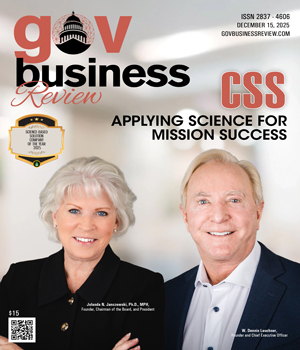
 Jolanda N. Janczewski, Ph.D., MPH, Founder, Chairman of the Board, and President and W. Dennis Lauchner, Founder and Chief Executive Officer
From the ocean floor to low Earth orbit, CSS supports scientific work that is often unseen but broadly consequential. For nearly four decades, the employee-owned company has contributed to some of the United States’ most critical research, monitoring, and response efforts.
Today, CSS is a trusted partner to more than two dozen federal agencies and a growing portfolio of commercial clients, including Blue Origin. Its teams conduct coral reef mapping, forecast environmental and climate risks, manage space-based experiments, and support chemical and biological emergency responses. Across environmental science, public health, and space exploration, CSS maintains a consistent mission: ensure science is operational, reliable, and serves the public good.
That breadth reflects a company that has expanded steadily without losing coherence. CSS was founded on a shared belief by Jolanda N. Janczewski, Ph.D., MPH and W. Dennis Lauchner that scientific rigor must be paired with practical judgment. They defined this philosophy as Scientific Minds, Common Sense Solutions, a principle that continues to guide CSS’s approach to applied research and operational support.
From Ocean Depths to Earth’s Orbits
CSS was founded in 1988 as a safety consulting firm supporting government projects. Over time, its scope expanded in response to evolving scientific needs, extending from deep ocean environments to orbital research platforms. This progression was driven by adaptability, technical curiosity, and long-term collaboration with client agencies.
We go where the science takes us. Sometimes that’s underwater, sometimes it’s in orbit. What matters is solving real problems with precision and purpose.
CSS operates wherever U.S. government science is conducted at scale. For NOAA, the company supports both the wet side and the dry side of environmental research. On the wet side, CSS has led decades of coral reef mapping and monitoring in the Caribbean and beyond. These efforts integrate remotely operated vehicle footage, diver-based observations, and satellite data. Artificial intelligence and machine learning are applied to rapidly screen and analyze video datasets, enabling continuous assessment of shallow and deep sea coral health critical to fisheries, coastal protection, and ecosystem stability.
On the dry side, CSS strengthened satellite analytics and predictive modeling capabilities through its acquisition of Riverside Technology. CSS also integrates AI into harmful algal bloom prediction, combining field measurements, satellite imagery, and model-generated data to anticipate red and green tide events and inform prevention strategies that mitigate health and economic impacts. These capabilities support forecasting and environmental intelligence across NOAA programs.

CSS further applies AI driven geospatial analysis to marine spatial planning. Their decision support tools integrate data on spawning and fishing grounds, military zones, and energy infrastructure to identify suitable locations for aquaculture and marine-generated energy production, including offshore oil, wind, and marine minerals. These tools support sectors accounting for approximately 24 percent of U.S. seafood value while balancing economic, environmental, and security considerations.
For NASA, CSS manages experiments destined for the International Space Station, operating research hardware and developing novel instrumentation. CSS supports investigators studying the effects of microgravity on biological and physical systems, providing expertise in protocol development, payload integration, and on-orbit mission operations to translate orbital data into terrestrial applications.
“We go where the science takes us. Sometimes that’s underwater, sometimes it’s in orbit. What matters is solving real problems with precision and purpose,” says Janczewski.
Applied Science for Health, Safety, and Resilience
Beyond environmental monitoring, CSS applies scientific methods to public health, conservation, and emergency preparedness. In marine biology, CSS developed a non-invasive sampling methodology using drones equipped with sterile biological collection media. These systems collect exhaled vapor from whale and dolphin blowholes, enabling assessment of animal health and exposure to environmental toxins without physical contact.
-
We provide the people and the brainpower. Helping government projects advance. We’re part of that collaboration.
In chemical and biological response, CSS chemists operate national response laboratories for the EPA and develop methods to identify contaminants during crisis events. The company also developed specialized standard operating procedures for personnel decontamination following investigations involving chemical warfare agents and biological hazards. These SOPs adapt traditional decontamination protocols for CBRN response environments, supported by detailed graphical layouts of decontamination lines and comprehensive classroom and field training for on-scene coordinators.
CSS has also become a leader in applying AI to environmental modeling, chemical analysis, and disaster prediction. Investments in computational infrastructure enable the company to deliver scalable, data-intensive solutions as agencies modernize their scientific operations.
Partnership Over Promotion
Its reputation has been built through nearly forty years of performance-based trust with federal agencies. Clients frequently describe CSS not as a contractor but as an extension of their own scientific teams.
“We wanted to make sure the company would last. Ownership gives everyone a reason to think like a leader. It keeps the focus on quality, not just growth.”
Many of these relationships span more than two decades, an uncommon tenure in federal contracting. CSS scientists and engineers are embed deeply within agency programs, providing continuity, mentorship, and institutional knowledge. This proximity allows CSS to anticipate emerging scientific needs, identify promising technologies, and propose solutions proactively rather than reactively.
 “We provide the people and the brainpower,” says Janczewski. “Helping government projects advance. we’re part of that collaboration.”
This partnership model also defines CSS’s role in NOAA’s Industry Proving Grounds initiative. Working alongside NOAA and industry leaders in architecture, engineering, reinsurance, and retail, CSS co-develop products that translate climate data into decision-ready tools. These efforts span the full product lifecycle and prioritize accessibility, risk assessment, and resilience planning, including support for underserved and vulnerable communities facing climate extremes.
Shared Ownership and Long-Term Growth
In 2012, CSS restructured with a Employee Owned Stock Plan (ESOP). Today, more than 400 employee owners hold a personal stake in the company’s performance and future. This model supports long-term retention, cross-disciplinary collaboration, and preservation of institutional expertise across oceanography, atmospheric science, chemistry, engineering, and data science.
“We wanted to make sure the company would last. Ownership gives everyone a reason to think like a leader. It keeps the focus on quality, not just growth,” says Lauchner.
CSS grows deliberately, combining organic expansion with selective acquisitions aligned to its scientific mission. The integration of Riverside Technology filled a critical gap in satellite analytics and predictive modeling while reinforcing NOAA’s dry-side capabilities. Flexibility remains central to CSS’s longevity. The company adapts as science and policy evolve, often identifying needs before agencies formally articulate them.
The approach has earned CSS multiple awards for exceptional public service. Trends and headlines do not drive the company’s direction. Its success is rooted in precision, humility, and sustained contribution.
As CSS continues to evolve, it demonstrates that a company built on scientific rigor, shared ownership, and long-term partnership can remain both resilient and relevant. Its work is quiet by design, but its impact is enduring.
Company : CSS
ManagementJolanda N. Janczewski, Ph.D., MPH, Founder, Chairman of the Board, and President and W. Dennis Lauchner, Founder and Chief Executive Officer